
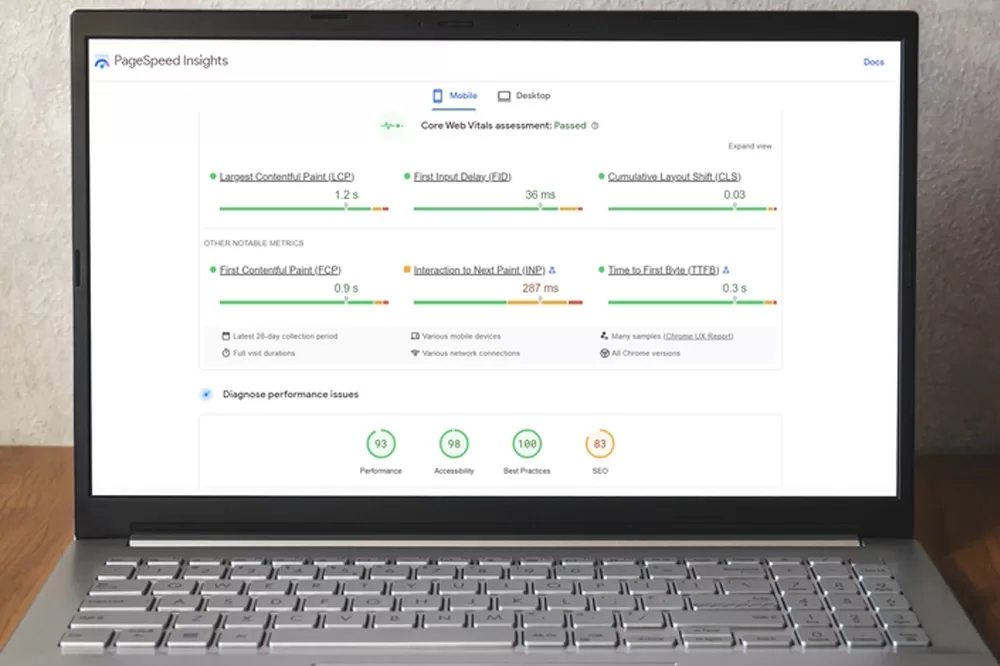
Website performance tools are valuable — but they’re not the final authority.
Over the years, we’ve seen businesses make major website decisions because a tool told them their score wasn’t high enough. Pages get stripped down. Features disappear. Conversion elements are removed. All in the name of chasing a number.
And while performance scores matter, blindly optimizing for a tool can do more harm than good.
Performance Scores Are Signals — Not the Goal
Tools like Google PageSpeed Insights and other performance platforms are designed to measure technical behavior under controlled conditions. They surface important insights such as:
- load times
- render blocking
- layout shifts
- script execution
These metrics matter — especially when a site is genuinely slow.
But tools don’t understand:
- your business model
- your conversion strategy
- your advertising stack
- your analytics and tracking requirements
- or how real users interact with your site
A performance score is a diagnostic signal, not a success metric.
The Trade-Offs Are Real
Modern websites are not static brochures.
They often rely on:
- ad conversion scripts
- analytics platforms
- CRM integrations
- call tracking
- heatmaps
- dynamic forms
- personalization tools
These systems exist to turn traffic into measurable outcomes.
Yes, they add weight.
Yes, they can lower performance scores.
And yes, removing them might push a site from a 70 to a 95.
But that improvement means nothing if:
- conversions stop tracking
- ad platforms lose optimization data
- leads drop
- or decisions are made without visibility
Optimizing away functionality just to raise a score isn’t optimization — it’s self-sabotage.
User Experience Always Comes First
Search engines don’t reward fast pages that frustrate users.
They reward sites that:
- load reasonably quickly
- feel responsive
- are easy to understand
- guide users clearly
- serve a real purpose
A clean, intuitive site that loads in a couple of seconds and converts well will outperform a stripped-down “perfect score” site that confuses visitors or fails to capture action.
Speed matters — but usefulness matters more.
Not All Performance Warnings Are Equal
Another common mistake is treating every warning as urgent.
Some issues:
- have minimal real-world impact
- only appear in lab testing
- vary by device, network, or browser
- are partially outside your control
Third-party scripts, browser behavior, ad platforms, and user devices all influence performance metrics.
That doesn’t mean these warnings should be ignored — it means they should be prioritized intelligently.
Where Performance Truly Matters
There are non-negotiables.
You don’t want:
- extremely slow load times
- blocked rendering for several seconds
- broken layouts
- unresponsive interactions
Pages that are genuinely slow will be penalized — both by search engines and by users who simply leave.
The goal isn’t perfection.
The goal is balance.
Why Chasing Scores Can Hurt SEO
Ironically, obsessing over performance tools can undermine SEO itself.
When sites remove:
- helpful content sections
- visual context
- trust signals
- conversion paths
They often see:
- lower engagement
- higher bounce rates
- weaker intent satisfaction
Search engines evaluate behavior — not just technical metrics.
A page that loads slightly slower but keeps users engaged, scrolling, and converting is a stronger SEO asset than a technically pristine page no one interacts with.
A Better Way to Think About Performance
Instead of asking:
“How do we get a 95?”
The better question is:
“What can we improve without harming experience or outcomes?”
That mindset leads to:
- smarter script loading
- cleaner layouts
- intentional design decisions
- performance gains users actually feel
Most importantly, it keeps the website aligned with its purpose.
How We Approach Performance at Absolutely Dominate
This is exactly where our role comes in.
We don’t ignore performance tools — and we don’t blindly obey them either.
For our partners, performance is handled holistically. We focus on real improvements that matter, without sacrificing the user experience just to satisfy a dashboard.
In practice, that means:
- keeping sites on current, stable PHP versions
- maintaining updated, secure servers
- serving images in modern formats like WebP
- compressing and sizing images correctly
- applying smart caching strategies
- writing clean, intentional code
- removing unnecessary bloat
All while protecting:
- clarity
- conversion paths
- tracking accuracy
- and real-world usability
We care about speed.
We care about experience.
And we care about results.
So while a page may score a 70 or an 80 — especially when running the scripts required for advertising and growth — it’s built to perform where it actually counts: with real users, on real devices, making real decisions.
That balance is intentional.
Because a fast site that doesn’t work is just as broken as a slow one.